Youth and Creativity in Action – The Current State of CCIs in Six Countries
The Digicreate Empower Research Report “Young People in the Cultural and Creative Industries – A Comparative Research and Feasibility Study” provides a comparative overview of youth engagement in Cultural and Creative Industries across Germany, Spain, Portugal, Serbia, Montenegro, and Bosnia and Herzegovina. Authored by the Nevladina Organizacija GLAS (NVO GLAS) team with contributions from all other partners, the report examines economic relevance, education systems, employment models, and structural challenges shaping youth participation in CCIs.
This blog post focuses on the general state of the CCI sector, education and skill development, and employment trends. These areas provide the strongest economic and labor market data and offer a solid foundation for understanding youth participation. The remaining sections will be explored in another article.
The full research report will be shared soon!
General Situation of the CCI Sector and Youth Involvement
Across the six countries, CCIs represent growing economic sectors with strong youth representation, particularly in audiovisual media, gaming, design, and digital production.
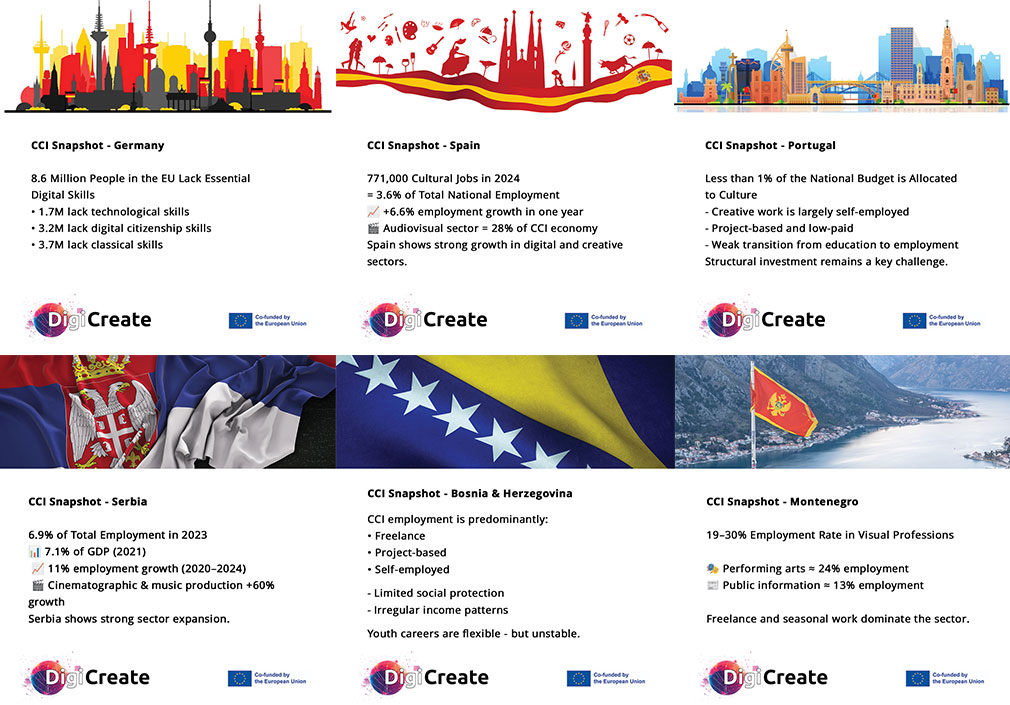
In Spain, cultural employment increased by 6.6% in 2024, reaching approximately 771,000 people, representing 3.6% of total national employment. The audiovisual sector accounts for around 28% of the CCI economy, with content creation growing by over 107% in five years (Cineuropa).
In Serbia, CCIs contributed 7.1% of GDP in 2021 and 6% of GDP in 2023, while employment reached 6.9% of total employment. The number of active enterprises in 2023 stood at 6,012, representing 4.4% of all registered companies.
In Montenegro, employment in creative sectors is largely freelance and project-based, with employment ratios in visual professions ranging between 19% and 30%.
Across all countries, micro-enterprises and self-employment dominate, reinforcing both flexibility and precarity.
Education and Skill Development
Formal education systems provide artistic and technical foundations, but gaps remain in entrepreneurial and digital competencies.
In Germany, a major EU-wide digital competence gap affects 8.6 million people, including 1.7 million lacking technological skills, 3.2 million lacking digital citizenship skills, and 3.7 million lacking classical skills.
Spain complements university education with vocational pathways aligned to national qualification frameworks, while Serbia and Montenegro increasingly rely on informal learning, workshops, and project-based training to bridge labor market gaps.
Portugal faces a documented disconnect between education and post-graduation employment, contributing to underemployment and early career instability.
Across all countries, hybrid learning and online platforms play a critical role in skills development, yet systematic integration into curricula remains uneven.
Employment and Skills
Employment in CCIs is expanding but remains structurally unstable.
In Serbia, employment in CCIs grew from 58,244 in Q4 2020 to 64,657 in Q4 2024, representing 11% growth. Cinematographic and music production employment expanded nearly 60% during this period.
In Montenegro, employment rates in the performing arts remain around 24%, while public information professions show employment rates as low as 13%, reflecting limited formal absorption capacity.
In Spain, young professionals face short-term contracts and intermittent income, prompting reforms under the Statute of the Artist to address social protection gaps.
Across all six countries, digital, entrepreneurial, and hybrid competencies are increasingly required. However, project-based work, freelance dependency, and regional disparities continue to define youth employment patterns in CCIs.
From Research to Real Opportunities: How DigiCreate Makes a Difference
Digicreate Empower responds directly to the gaps identified in this research. Many young people in the Cultural and Creative Industries have strong creative talent, but lack digital and entrepreneurial skills that are increasingly essential in today’s market. Through international virtual exchanges, Digicreate Empower brings together 2,500 young people aged 18–30 from six countries to learn, collaborate, and grow together.
By developing the Digicreate Empower Methodological Framework, the Creative Hive Open Digital Toolbox, an online platform, and structured online courses, the project offers accessible, high-quality non-formal learning opportunities without requiring physical mobility. In doing so, Digicreate Empower supports young creatives in building digital competencies, strengthening intercultural understanding, and turning their creativity into more sustainable career paths.
Funding Agency: EACEA – European Education and Culture Executive Agency